Few places in Europe make the Cold War feel as immediate as Berlin. For nearly three decades, the Berlin Wall cut through streets, divided families and turned short journeys across the city into tightly controlled border crossings. Much of the concrete has disappeared, but the places that remain tell very different parts of the story.
If you have only one stop, make it the Berlin Wall Memorial on Bernauer Straße, where a surviving border strip reveals how the fortifications worked. Add the East Side Gallery to see how the Wall became a canvas for art after 1989, and the Palace of Tears to understand the personal experience of separation. Most of these sites are free.
Why the Berlin Wall was built
Although Berlin had been divided into occupation sectors after the Second World War, the physical border was suddenly sealed by East German authorities on 13 August 1961. East Germany was losing large numbers of residents who could reach West Berlin, and the new barrier was designed to stop that movement.
The Wall developed into an extensive border system: concrete barriers, patrol roads, watchtowers and guarded areas. Escape attempts included tunnels, improvised crossings and extraordinary acts of courage, but crossing could be fatal. Families and neighbourhoods were separated for years.
On 9 November 1989, East Germany opened its border crossings amid protests and rapid political change. Berliners celebrated on and around the Wall; Germany was formally reunified on 3 October 1990. To appreciate the human consequences as well as the famous images, visit more than one site.
1. Berlin Wall Memorial: where to understand the border
The Berlin Wall Memorial stretches along Bernauer Straße, one of the most revealing streets in divided Berlin. Here, residential buildings stood directly on the border. In August 1961, people escaped from apartment windows onto the West Berlin pavement before the windows were bricked up and buildings were later demolished.
The open-air exhibition traces the former border, with information panels, historic photographs and the Window of Remembrance honouring people who died at the Wall. The preserved border strip lets you see why the border was far more than a single concrete wall. Across the road, the Documentation Centre explains the history of division, and its observation platform overlooks the fortifications.
Give this site 90 minutes to two hours. The outdoor exhibition is accessible daily from 8 a.m. to 10 p.m. The Documentation Centre normally opens Tuesday to Sunday, 10 a.m. to 6 p.m., and admission is free. Its address is Bernauer Straße 111, 13355 Berlin; the nearby S-Bahn stop is Nordbahnhof. Check the official visitor information for any changes.
2. East Side Gallery: when the Wall became art
The East Side Gallery is perhaps Berlin’s most photographed surviving section of the Wall. Extending for roughly 1.3 kilometres beside Mühlenstraße, it became an open-air gallery when international artists painted the concrete after the border opened.
The murals cover hope, freedom, political change and the tensions surrounding reunification. Famous works include Dmitri Vrubel’s depiction of the embrace between Leonid Brezhnev and Erich Honecker, and Birgit Kinder’s image of a Trabant apparently breaking through the Wall. These are not simply decorative backdrops: the paintings are part of the site’s post-1989 history.
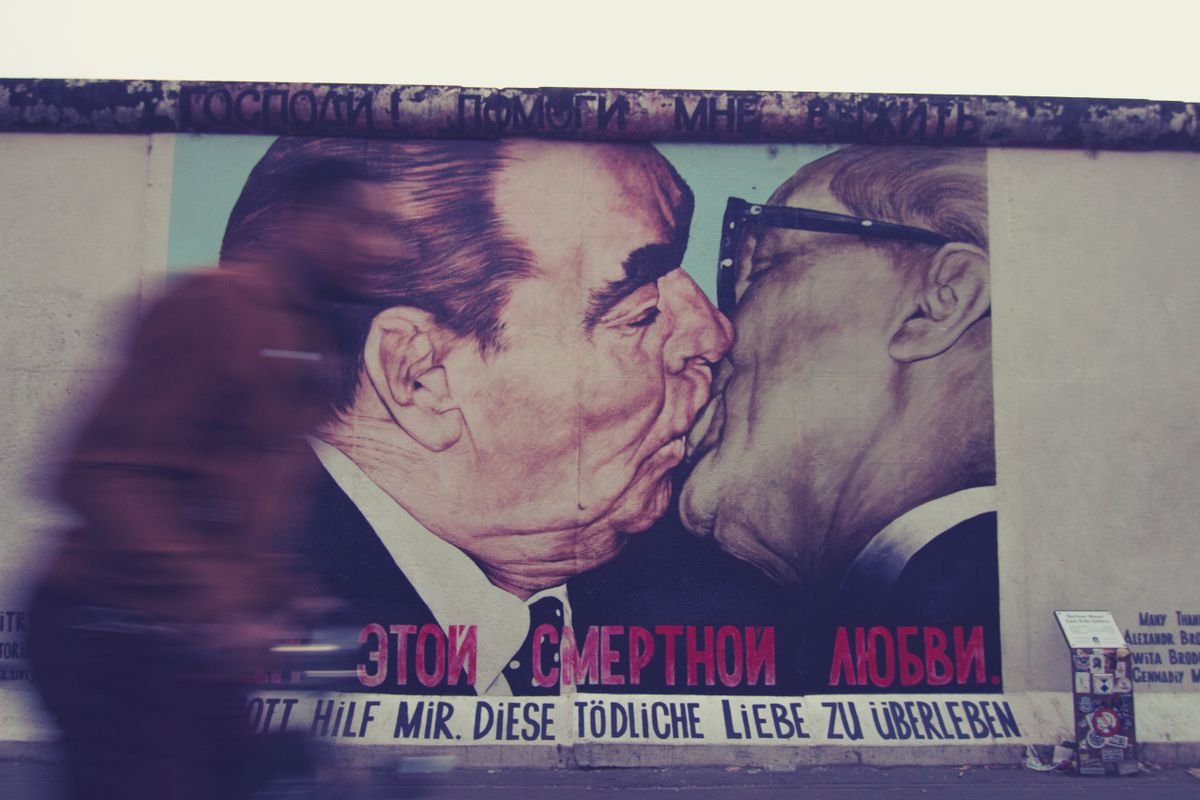
Walk the full length rather than stopping only at the best-known murals; allow around 45–75 minutes. Access is free and the gallery is open around the clock. Ostbahnhof is a convenient starting point, and the walk toward Oberbaumbrücke leads to good views of the Spree. The visitor information centre may have different hours from the outdoor gallery.
3. Palace of Tears: what crossing the border felt like
The Tränenpalast, or Palace of Tears, stands next to Friedrichstraße railway station. During the Cold War it was used for departures from East Berlin to West Berlin, and its nickname recalls the painful farewells that happened inside.
Its exhibition takes a more intimate approach than the outdoor memorials. Documents, objects and first-hand accounts show the bureaucratic procedures and emotional pressures of crossing a fortified border. It is an excellent second stop after Bernauer Straße, particularly if you want to understand how the Wall affected ordinary lives.
Admission is free. Opening hours are normally Tuesday to Friday, 9 a.m.–6 p.m., and Saturday and Sunday, 10 a.m.–6 p.m.; it closes on Mondays. The address is Reichstagufer 17, 10117 Berlin.
4. Should you visit Checkpoint Charlie?
Checkpoint Charlie was a famous crossing point between East and West Berlin, associated with diplomatic confrontation during the Cold War. It is easy to include while visiting central Berlin, but the familiar checkpoint hut is a reconstruction and the surrounding streets have changed greatly.
It is worth a short stop if the history of international relations interests you. If you have limited time, however, prioritise Bernauer Straße for a fuller understanding of the border itself. You can see the outdoor checkpoint location without a ticket; nearby commercial exhibitions charge separately.
A practical one-day Berlin Wall itinerary
Morning: Bernauer Straße
Start at the Berlin Wall Memorial around 10 a.m. Explore the preserved border strip, the Window of Remembrance and the Documentation Centre. If you have time, visit the nearby exhibition about the city’s former ghost stations at Nordbahnhof.
Midday: Friedrichstraße
Take public transport to Friedrichstraße station and visit the Palace of Tears. Afterward, have lunch in Mitte. This route works particularly well on Tuesday through Sunday, when the indoor exhibitions are normally open.
Afternoon: East Side Gallery
Travel by S-Bahn to Ostbahnhof, then follow the Wall paintings east toward Oberbaumbrücke. Pause at the less familiar murals and finish beside the River Spree. Allow five to six hours overall for the three main sites with lunch and transport, or longer if you join a guided walk.
Visiting Berlin for longer? Use Wordtheque’s three-day Berlin itinerary to combine the Wall with Museum Island, Brandenburg Gate and other neighbourhoods.
Practical tips before you go
- Most major memorial sites are free. You do not need to buy a ticket just to visit Bernauer Straße, the East Side Gallery or the Palace of Tears.
- Check Monday closures. The outdoor attractions remain accessible, but the Documentation Centre and Palace of Tears normally close.
- Use public transport. These locations are spread across different districts. Check current S-Bahn, U-Bahn and tram services rather than trying to walk the entire route.
- Visit respectfully. Bernauer Straße is a memorial to people who suffered and died under the border regime, not simply a photography location.
- Read the site information. Temporary exhibitions, special events and holiday hours can change. Check official sources before travelling.
Frequently asked questions
Can you still see the original Berlin Wall?
Yes. Original sections survive at Bernauer Straße, the East Side Gallery and several other locations. Different places preserve different aspects of the former border.
Which Berlin Wall site is best for first-time visitors?
Choose the Berlin Wall Memorial if you have time for only one. Its preserved border strip and exhibitions explain how the Wall functioned and what it meant to nearby residents.
How long should I spend at the Berlin Wall?
Allow at least two hours for Bernauer Straße. Half a day covers two principal sites; a full day makes it easier to visit the memorial, Palace of Tears and East Side Gallery without rushing.
Why a visit still matters
At Bernauer Straße, the Wall is a story of families, homes and escape attempts. At the Palace of Tears, it is a story of separation and difficult departures. At the East Side Gallery, it becomes a record of artistic responses to freedom and change. Visiting all three makes Berlin’s division more than a familiar photograph from a history book.
Image credit: Photo of the East Side Gallery by Javier Gonzalez / Pexels, available under the Pexels License. The photograph has been resized for web display.