Sistine Chapel Ceiling Explained: What You’re Seeing and Why It Matters (Beginner-Friendly Guide)
Standing under the Sistine Chapel ceiling can feel overwhelming. You know you are looking at one of the most famous works of art in the world, but from the floor it is not always obvious what you are actually seeing, where to look first, or why certain figures matter. This beginner-friendly guide to the Sistine Chapel ceiling will help you make sense of the main scenes, the surrounding figures, and the visual details that make the whole room so memorable.
By the end, you will know how to read the ceiling in a simple, practical way: what the central panels show, why prophets and sibyls surround them, and which details are worth noticing even during a short visit. If you want context without needing an art history degree, this guide is for you.
Key Takeaways
- The Sistine Chapel ceiling is not one single image but a large, carefully organized program of scenes and figures.
- The central panels focus mainly on stories from Genesis, including the famous Creation of Adam.
- The prophets and sibyls around the central scenes help frame the ceiling as a story of expectation and revelation.
- What looks confusing at first becomes easier to follow when you break it into zones: central scenes, surrounding seers, ancestors, and corner scenes.
- You do not need to identify every figure to enjoy the ceiling; noticing structure, movement, and emotion already adds a lot to the experience.
Why the Sistine Chapel ceiling feels hard to read at first
It is a huge work viewed from far below
One reason the Sistine Chapel ceiling can feel confusing is simple: you are standing far away from it. The figures are large, but the entire painted program spreads across a complex ceiling with many sections, frames, and architectural illusions.
From the chapel floor, your eye may jump straight to the best-known image, the Creation of Adam, and miss how much else is happening around it. That is normal. The ceiling is easier to understand when you stop thinking of it as one painting and start seeing it as a sequence of connected parts.
There is more than one story happening
Most first-time visitors expect a straightforward biblical narrative. Instead, the ceiling combines scenes from Genesis with prophets, sibyls, ancestors of Christ, and dramatic corner images from the Old Testament.
In other words, it is not just telling one story. It is building a larger religious and visual argument through many figures placed in different zones.
Quick Tip: If you only have a few minutes inside, focus first on the central Genesis scenes, then look outward to the larger seated figures around them. That simple viewing order makes the ceiling much easier to follow.
How the ceiling is organized
The central panels are the easiest place to start
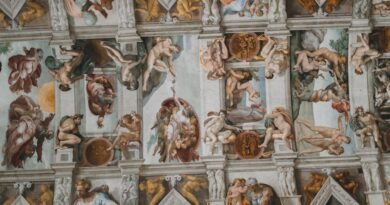
The middle of the ceiling contains the narrative scenes most visitors notice first. These panels present episodes from the Book of Genesis, including creation, humanity’s fall, and the story of Noah.
According to visitor guides and educational resources, the scenes are best understood as a sequence rather than isolated images. A useful overview appears in Smarthistory’s introduction to Michelangelo’s Sistine Chapel ceiling, which helps place the work within the chapel as a whole.
The surrounding figures create the larger meaning
Around the central panels sit monumental figures usually identified as prophets and sibyls. These are not decorative extras. They help connect the Genesis scenes to the broader Christian reading of history and expectation.
Elsewhere, smaller groups and architectural frames create a layered effect. The result is a ceiling that feels sculptural even though it is painted.
| Zone of the ceiling | What to look for |
|---|---|
| Central panels | Main Genesis scenes such as creation, temptation, and Noah |
| Prophets and sibyls | Large seated figures framing the central story |
| Corner scenes | Dramatic Old Testament episodes |
| Smaller surrounding figures | Supporting characters, ancestors, and decorative structure |
The main Genesis scenes you are probably noticing
The Creation of Adam
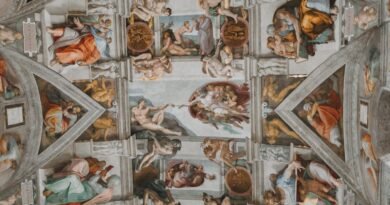
This is the image most people come ready to recognize: Adam reclining on the earth, God reaching toward him, their hands almost touching. Even if you know nothing else about the Sistine Chapel ceiling, this scene usually stands out because it is visually simple and emotionally direct.
What makes it powerful is the tension in the gap between the fingers. The scene captures a moment of near-contact, which gives it energy and drama without needing a lot of action.
The Creation of Eve
In this panel, Eve rises toward God in a gesture that feels more formal and devotional. Compared with the Creation of Adam, it often gets less attention from visitors, but it is worth pausing over because it shows a different kind of relationship between human and divine figures.
The composition is more vertical and concentrated. That change in structure helps distinguish one creation scene from another.
The Temptation and Expulsion
This scene combines two moments into one image. On one side, Adam and Eve encounter temptation; on the other, they are driven out of Eden.
It is a good example of how the ceiling often compresses narrative. Instead of treating each event separately, the image lets you compare innocence and loss in a single glance.
Noah scenes and the human aftermath
The cycle also includes scenes linked to Noah, such as sacrifice, the flood, and drunkenness. These are important because they shift the focus from the first human pair to humanity more broadly, showing failure, survival, and vulnerability.
If you want a concise list of the central scenes, this overview of the Sistine Chapel ceiling on Wikipedia is a practical reference before or after a visit.
Who are the large seated figures around the center?
The prophets
The male figures seated around the central scenes are Old Testament prophets. They are shown as powerful, thoughtful, and often physically intense, with twisting poses and heavy drapery.
Even if you cannot identify each one, you can still notice their role. They act almost like anchors, giving the ceiling rhythm and gravity.
The sibyls
The sibyls are female seers from the ancient world. Their presence surprises many visitors, but they are part of the larger idea that truth or prophecy was not limited to one group alone.
Visually, they are among the most striking figures on the ceiling. They often have strong poses, large bodies, and a sense of concentration that makes them feel as important as the prophets.
Why they matter for beginners
If you are trying to understand what you are seeing in the Sistine Chapel ceiling, the key point is this: these figures are there to frame the Genesis scenes within a bigger story of expectation. They are not random characters placed between the main pictures.
A helpful explanation of these surrounding figures appears in this guide to the Sistine Chapel frescoes, which highlights the prophets and sibyls specifically.
What to notice beyond the famous images
The body language is part of the meaning
One of the fastest ways to appreciate the ceiling is to watch the bodies. Figures stretch, twist, lean, recoil, and reach in ways that make the scenes feel active rather than static.
You do not need to know every name to see this. The physical energy tells you a lot about tension, struggle, authority, and emotion.
The painted architecture organizes your eye
Much of what looks like carved framing is painted illusion. These architectural elements help separate scenes and create order across the ceiling.
For a beginner, this matters because it gives you a viewing map. The painted framework is one reason the huge composition does not collapse into chaos.
Scale changes help emphasize importance
Not all figures are the same size, and that is part of the design. The larger seated figures feel monumental, while some smaller groups play supporting roles.
This difference in scale helps guide attention. It tells you where the visual weight of the ceiling lies.
Quick Tip: If the ceiling starts to blur together, pick one panel and one seated figure beside it. Looking at a small pair of elements often helps you reconnect with the larger structure.
How to look at the ceiling during a real visit
Do not try to decode everything at once
Many travelers make the visit harder than it needs to be by trying to identify every scene in real time. A better approach is to have a simple plan.
Start with the central narrative. Then notice the large seated figures around it. Finally, take in the overall effect of color, movement, and scale.
Use a three-step viewing method
- Find the Creation of Adam as your visual anchor.
- Look left and right to see that it belongs to a larger Genesis sequence.
- Lift your attention outward to the prophets and sibyls framing the story.
This method works well for short visits, crowded conditions, and first-time viewers. It gives you structure without overloading you.
Remember that the chapel is more than the ceiling
Although this guide focuses on the Sistine Chapel ceiling, the room includes much more. The walls and altar wall matter too, and the chapel functions as a religious space, not just a museum stop.
If you want a fuller room-by-room perspective, Wordtheque’s own guide to Sistine Chapel highlights is a helpful next read.
Common mistakes beginners make when viewing the Sistine Chapel ceiling
Focusing only on one image
The Creation of Adam deserves its fame, but it is only one part of the whole. If you stop there, you miss the narrative and symbolic structure that gives the ceiling its depth.
Assuming every figure is part of the same scene
Because the composition is dense, some visitors assume all the figures belong to one continuous story. In fact, the ceiling is divided into distinct sections with different roles.
Once you understand that, the apparent complexity becomes much more manageable.
Expecting a calm, orderly look from every panel
Some scenes are clear and balanced, while others feel crowded or dramatic. That variation is part of the experience.
The ceiling is not meant to read like a neat illustrated handbook. It mixes clarity, tension, and visual force.
Frequently Asked Questions
What is the main thing to look for on the Sistine Chapel ceiling?
Start with the central Genesis scenes, especially the Creation of Adam. Then look at the large seated prophets and sibyls around them to understand the broader structure.
Is the Creation of Adam the whole ceiling?
No. It is just one of several central panels. The full Sistine Chapel ceiling includes multiple Genesis scenes plus many surrounding figures and supporting images.
Do I need to know Bible stories to understand the ceiling?
No. Knowing a few basic stories helps, but you can still appreciate the ceiling by noticing the organization, gestures, emotion, and contrast between scenes.
Why are there women seated around the ceiling if the main scenes are from Genesis?
Some of the large seated figures are sibyls, female seers from the ancient world. They are included alongside prophets as part of the ceiling’s larger message about prophecy and expectation.