George Orwell is often introduced through a single warning: a government can make the truth disappear. His writing offers a much wider education than that. Alongside Nineteen Eighty-Four and Animal Farm are accounts of poverty, imperial service, civil war and the everyday habits of English life. Reading across those forms reveals a writer who kept asking how people justify power, including when the justification comes from their own political side.
Eric Blair and the making of George Orwell
Orwell was born Eric Arthur Blair on 25 June 1903 in Motihari, British India. Educated in England, he served in the Indian Imperial Police in Burma before returning to Europe and becoming a writer. George Orwell was the name under which Down and Out in Paris and London appeared in 1933. D. J. Taylor’s biography for the Orwell Foundation traces the movement between imperial employment, insecure literary work and political commitment.
Experiences of poverty informed his early books; investigation of working-class conditions in northern England led to The Road to Wigan Pier. He went to Spain during the civil war, fought with a militia associated with the POUM, and was wounded. Homage to Catalonia grew out of that experience and the political conflict within the Republican side. During the Second World War he worked for the BBC, later becoming literary editor of Tribune. He died of tuberculosis in London on 21 January 1950.
The major books, in publication order
The Orwell Society’s bibliography distinguishes his fiction from reportage and records the publication sequence. These are useful starting points:
- Down and Out in Paris and London (1933): poverty, insecure work and life near the edges of two capitals.
- Burmese Days (1934): a novel set within the social world of British colonial rule.
- The Road to Wigan Pier (1937): an investigation of industrial living conditions followed by an argument about class and socialism.
- Homage to Catalonia (1938): an account of Spain that combines wartime experience with political explanation.
- Animal Farm (1945): a short political fable about a revolution and its betrayal.
- Nineteen Eighty-Four (1949): a novel about totalitarian power, language, memory and private loyalty.
This is a reading selection, not his complete bibliography. It leaves room for the less frequently assigned novels and for the essays, which are central to his achievement rather than extras attached to two famous books.
Where should a new reader begin?
For a first encounter, choose the form you already enjoy. Animal Farm offers a compact narrative; Homage to Catalonia suits readers drawn to eyewitness accounts; an essay is a manageable way to meet Orwell’s argumentative voice. Starting with Nineteen Eighty-Four is equally reasonable, but it need not determine everything you expect from him afterwards.
A useful second step is to change genres. Follow a novel with reportage, or an essay with a novel. Ask how Orwell establishes credibility in each: through observed detail, a narrator’s experience, political argument or an invented world. That comparison makes it harder to treat every sentence he wrote as the same kind of evidence. A fictional character’s statement is not automatically the author’s position; a memoir remains a perspective that can be compared with other historical accounts.
Politics without a convenient party label
In “Why I Write” (1946), Orwell describes opposition to totalitarianism and support for democratic socialism as defining purposes of his mature work. He also explains his desire to combine political purpose with artistic expression. This is Orwell’s own account of his aims, not a claim that every book perfectly fulfils them.
Read that essay beside a book rather than using it as a substitute for one. Which passages invite emotional involvement, and which argue directly? Where does an image do work that an abstract political statement could not? These questions allow the literature to remain literature while taking the politics seriously.
Language, criticism and the essayist
“Politics and the English Language” (1946) links stale expression and political evasion. Orwell examines habits that let a writer avoid specifying an action or accepting responsibility for it. Its practical value is not a ban on all difficult vocabulary. Try applying its questions to a passage: who acts, what happens, and what does the wording obscure?
The literary essays also resist comfortable agreement. In his 1942 essay on Rudyard Kipling, Orwell considers the force and popularity of writing whose politics he sharply disputes. Readers can set that argument beside Wordtheque’s introduction to Kipling and his poems. Admiration for a writer’s craft and criticism of the writer’s assumptions need not cancel each other out.
Reading beyond the familiar warnings
Keep a distinction between Orwell’s historical circumstances and the present-day comparisons his books invite. Recognising a resemblance is the beginning of an argument, not proof that two societies are identical. Name the specific mechanism you are comparing, then ask what differs.
For another route through English writing about social conditions, explore Charles Dickens’s life and major novels. The contrast offers a useful reading exercise: how do humour, sympathy and the choice of narrator affect a book’s social criticism? Orwell becomes more interesting when read among other writers, with room for disagreement, rather than as a collection of predictions and slogans.
Sources and image credit
The linked sources distinguish biographical reference, publication records and Orwell’s own essays. The Orwell Foundation’s essay index offers further primary reading.
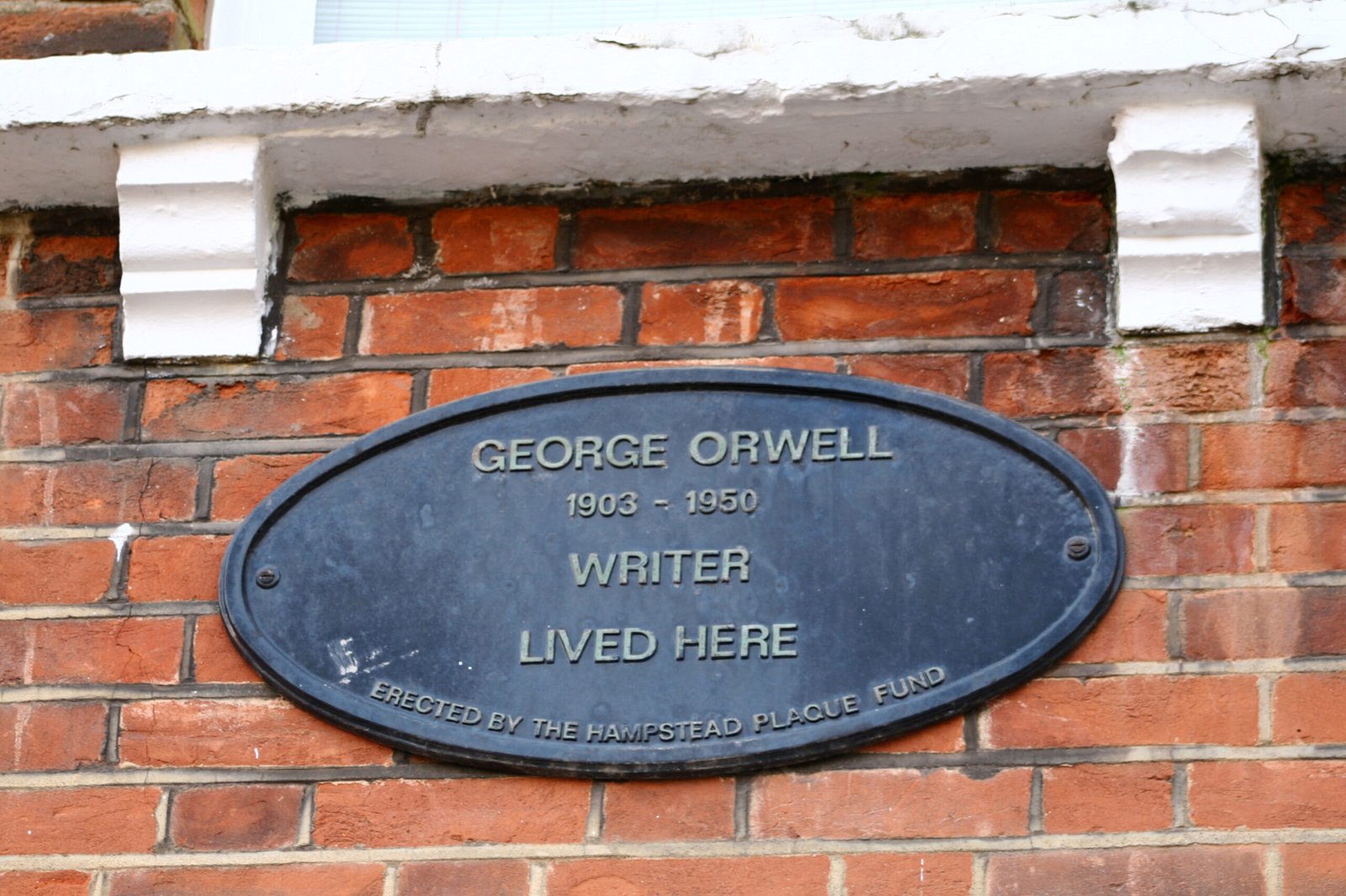
Photo credit: Paolo Margari, George Orwell memorial plaque, Wikimedia Commons, 31 March 2007. CC BY-SA 2.0. Scaled for web display; not cropped.