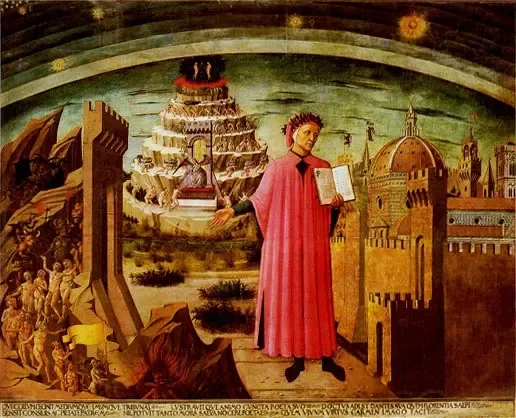
Dante Alighieri wrote a journey through the afterlife that is also crowded with the concerns of earthly life: friendship, love, civic conflict, reputation and the use of language. Yet the author of the Divine Comedy was more than the traveller encountered in its opening lines. He was a Florentine poet and political exile whose other works help explain how a personal voice could grow into such an ambitious public poem.
A Florentine life interrupted by exile
Dante was born in Florence in 1265 and died in Ravenna in 1321. The Poetry Foundation’s biographical overview places his poetry within Florence’s intellectual and political life. Conflict between political factions led to his exile in 1302. He never returned to live in his native city.
That displacement matters when reading a poem filled with judgements about cities, rulers and citizens. Dante writes about belonging from outside Florence. But biography should not become an automatic answer to every passage: the historical author, the narrator looking back and the pilgrim who learns during the journey are related roles, not interchangeable ones. Keeping them apart helps explain why the pilgrim can be confused when the larger poem appears to judge so confidently.
Beatrice and the experiment of the Vita nuova
Before the Comedy, Dante assembled the Vita nuova, a work combining lyric poems with prose narration and commentary. Beatrice is its central beloved figure. Instead of presenting an uninterrupted sequence of events, the book asks readers to move between emotional experience, poetic expression and retrospective explanation.
In his Yale lecture on the Vita nuova, scholar Giuseppe Mazzotta treats the book as an apprenticeship in both love and poetry. He explores how the writer’s attempt to understand love becomes inseparable from the discovery of a poetic voice. This is an identified scholar’s interpretation, useful to test against the work itself rather than accept as its only possible meaning.
For a first reading, notice what the prose adds to a poem. Does it clarify the circumstances, explain a choice of words, or guide your judgement of the speaker? Then ask what would change if the poem stood alone. The exercise is particularly helpful for readers who know Dante only as the author of a vast, continuous narrative.
What is the Divine Comedy?
The poem moves through Inferno, Purgatorio and Paradiso: Hell, Purgatory and Paradise. Its 100 cantos organise an imagined journey through moral and spiritual experience. Virgil and Beatrice have different guiding roles, and the poem’s Christian framework repeatedly encounters classical literature, history and contemporary Italian politics.
Wordtheque’s introduction to the Divine Comedy treats the work separately. The distinction is useful: a biography explains a writer’s circumstances, while a guide to the poem must also attend to structure, speakers and the experience of reading. Knowing the author’s dates will not by itself explain why an encounter moves the pilgrim or unsettles a reader.
Dante beyond his best-known work
The Princeton Dante Project brings together the Italian text, translation and commentary on the Comedy, together with Dante’s minor works. These provide several routes beyond the famous journey. Convivio connects poetry with philosophical explanation; De vulgari eloquentia considers vernacular eloquence; Monarchia addresses political authority. Their different purposes remind us that Dante’s literary career cannot be reduced to one genre.
You need not finish all of these works before attempting the Comedy. A more manageable approach is to follow a question. If the relationship between poetry and argument interests you, turn towards Convivio. If the choice of a literary language catches your attention, investigate De vulgari eloquentia. Read introductions that identify a text’s form and historical circumstances before drawing conclusions from an isolated extract.
Why language matters
Dante’s major vernacular poetry helped give Italian an enduring literary model. For an English-language reader, however, every encounter with that poetry also involves a translator’s decisions. Sound, syntax, line length and explanatory clarity cannot all transfer unchanged between languages.
Compare a short passage in two versions. Which makes the speaker easier to follow? Which preserves more of the movement from line to line? A version that works well aloud may serve a different purpose from one chosen for close study. Wordtheque’s guide to choosing a Divine Comedy translation develops these practical questions. There is little advantage in selecting an edition so forbidding that you never begin.
How to read a poet who judges his world
When a character speaks, pause before turning the speech into a general statement of Dante’s beliefs. Ask who is speaking, what situation frames the account, and how the pilgrim responds. Sympathy and judgement can pull in different directions; that tension is a reason to keep reading, not an inconvenience to remove with a quick moral label.
Use notes to identify a person or political event, then return to the scene. A good first reading does not require mastery of every medieval controversy. It does require willingness to let an unfamiliar worldview remain unfamiliar long enough to understand its questions. The author profile, the poem, a translation and a scholarly commentary each supply a different part of that encounter.
Sources and image credit
Biographical reference: Poetry Foundation. Primary texts and commentary: Princeton Dante Project. Named scholarly interpretation: Giuseppe Mazzotta, Open Yale Courses, Dante in Translation, lecture 2. All are linked above.
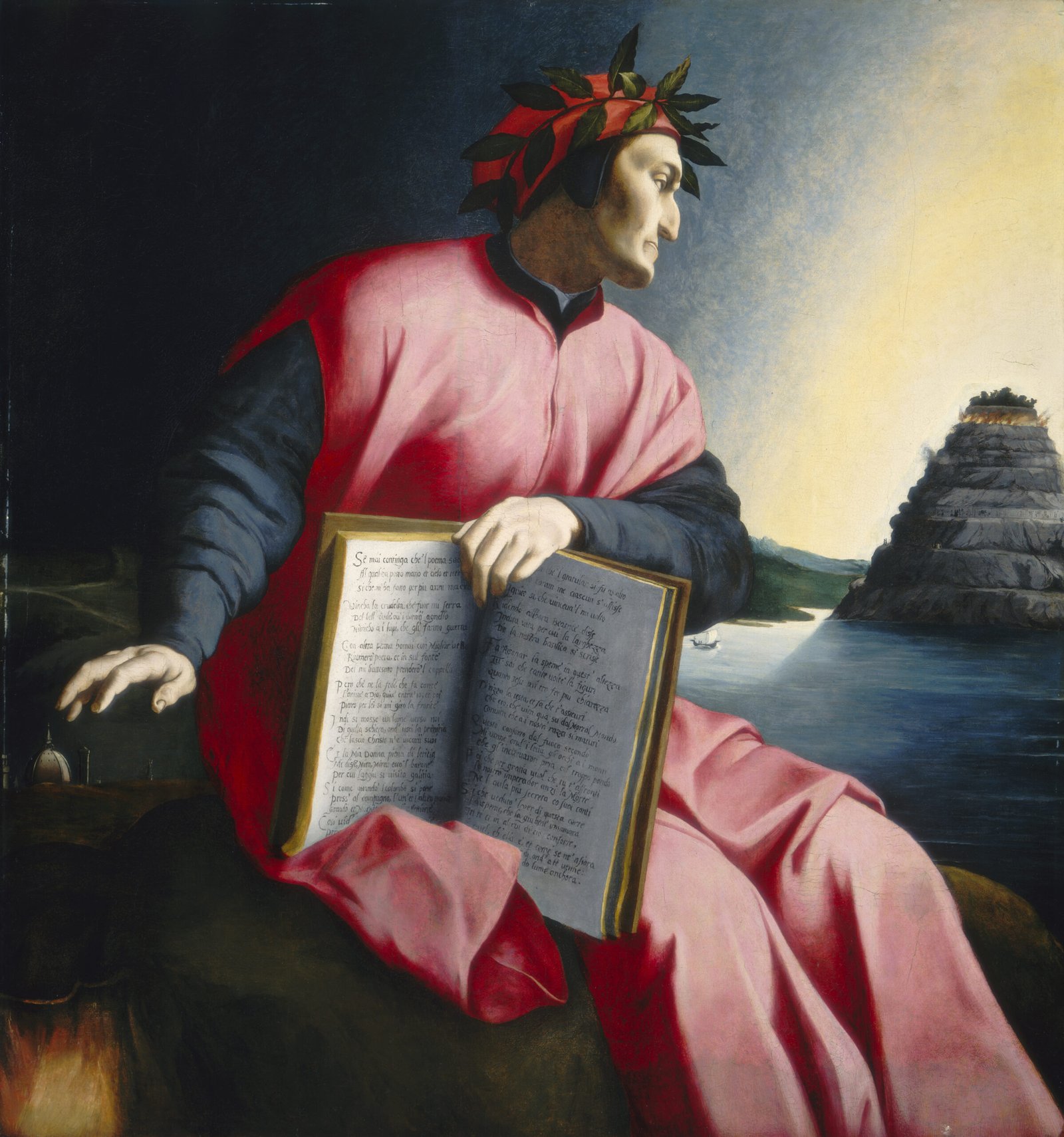
Image credit: Florentine sixteenth-century artist, Allegorical Portrait of Dante, late sixteenth century, National Gallery of Art, Samuel H. Kress Collection, accession 1961.9.57, via Wikimedia Commons. CC0 1.0. Scaled for web display; not cropped.