Konrad Lorenz (1903–1989) was an Austrian zoologist whose books helped introduce a wide readership to ethology, the biological study of animal behaviour. In King Solomon’s Ring and Man Meets Dog, ordinary encounters with birds, fish and domestic animals become occasions for explaining how behaviour develops. His later On Aggression is more contentious, particularly when he extends explanations of animal behaviour to human society.
From zoology to the Nobel Prize
Lorenz was born in Vienna in 1903 and studied medicine and zoology at the University of Vienna. His interest in the behaviour of birds developed through keeping and watching animals at his family’s home in Altenberg. Rather than treating animals simply as experimental subjects, he observed their interactions over extended periods and asked how particular behaviour fitted into the lives of different species.
In 1973 he shared the Nobel Prize in Physiology or Medicine with Karl von Frisch and Nikolaas Tinbergen. The three scientists brought different approaches to understanding behaviour: von Frisch investigated communication in bees, Tinbergen combined observation and experiment, and Lorenz studied instinct and learning, especially in birds. The Treccani history of ethology places Lorenz’s research in this wider scientific movement.
King Solomon’s Ring (1949)
Originally published in German as Er redete mit dem Vieh, den Vögeln und den Fischen, this book takes its English title from the legend of a ring that allowed Solomon to understand animals. It is a collection of accounts of living with animals and noticing their distinctive ways of communicating, responding and forming social relationships.
The book’s range is part of its appeal. It moves from the aquarium to birds and mammals, illustrated with Lorenz’s own drawings. Its chapter on animal communication is a useful starting point for readers who want to see how questions about signals can arise from familiar observations. The book also makes an interesting companion to Henry David Thoreau’s nature writing: both authors ask readers to pay closer attention to the non-human world, although their purposes and methods differ.
Man Meets Dog (1950)
First published in German as So kam der Mensch auf den Hund, this is the natural next choice for readers who share their homes with pets. Lorenz discusses relationships between people and dogs, the differences between individual animals, training, play and the emotional demands of companionship. Cats also appear. The Routledge edition of Man Meets Dog includes his illustrations and chapters on dogs and children, breeding and feline behaviour.
Readers should distinguish the author’s experiences and historical hypotheses from present-day veterinary or training advice. A book from the middle of the twentieth century can offer revealing observations without being an up-to-date manual on canine behaviour.
On Aggression (1963)
In Das sogenannte Böse, translated into English as On Aggression, Lorenz considers the biological significance of fighting between members of the same species. The book explores social organisation, territorial behaviour and the ways in which animal conflicts can be regulated.
Its discussion of human aggression has provoked much more disagreement than its descriptions of animals. The Routledge edition identifies this extension to human affairs as a central source of controversy. Readers interested in the distinction between observations and testable explanations may also find Karl Popper’s writings on scientific method useful. Lorenz’s hypotheses about human societies should not be taken as proof that human conflict is unavoidable.
What is imprinting?
Lorenz became particularly associated with imprinting, a form of early learning. Young birds may become attached to and follow an object or individual encountered during a sensitive stage of development. This phenomenon helped researchers investigate how inherited tendencies and experience interact. It is not simply a matter of an animal instantly recognising the first thing it sees.
For an account of subsequent experimental work, see the review Imprinting (2013) in WIREs Cognitive Science. It discusses the neural basis of learning and memory in domestic chicks, including sensitive periods and the influence of sleep on the retention of learned information.
The difficult history behind the books
Lorenz’s scientific achievements do not erase his involvement in National Socialism. The University of Vienna’s historical biography documents his membership of the Nazi Party in 1938 and his involvement in racial-policy work. His wartime publications promoted eugenic ideas, drawing unjustified conclusions about human worth from biological concepts.
In 2015 the University of Salzburg revoked an honorary doctorate it had awarded him in 1983. The Austrian Academy of Sciences’ biographical account also discusses his political commitments. These records are important companions to his popular writing, especially where claims about animal domestication become arguments about human society.
Reading Lorenz in English or Italian
For a first encounter, choose the illustrated animal stories in King Solomon’s Ring. Move to Man Meets Dog if your interests lie closer to domestic animals. Read On Aggression alongside modern scientific and historical scholarship rather than treating it as a final account of human nature. The Italian Treccani biography of Konrad Zacharias Lorenz provides an accessible overview of his career and ideas. His books remain useful for understanding the history of animal-behaviour writing and the questions that later researchers have pursued.
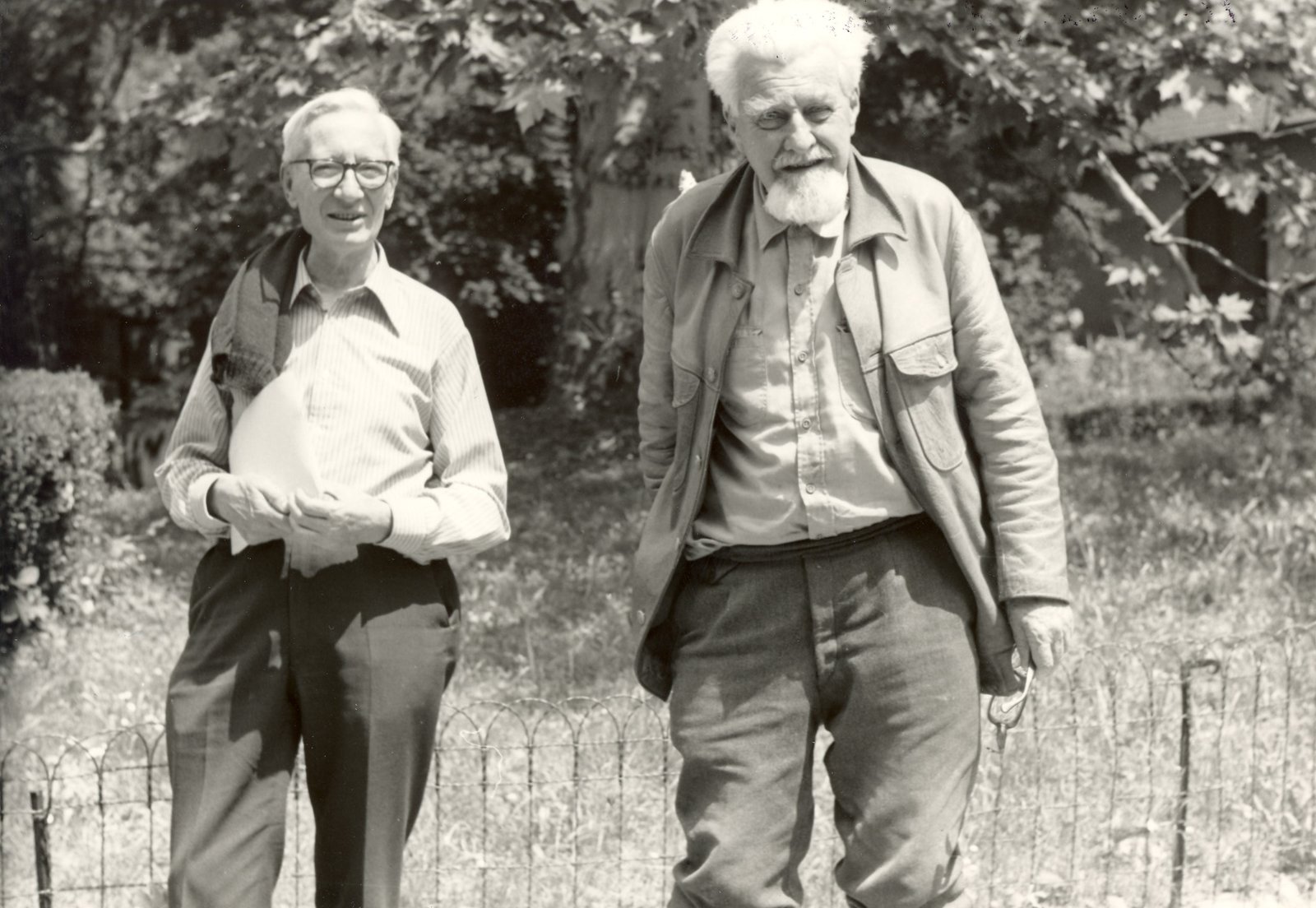
Image credit: Max Planck Gesellschaft/Archiv, Lorenz and Tinbergen1.jpg (1978), via Wikimedia Commons, CC BY-SA 3.0. Previously cropped by Ras67; displayed at reduced size.