Around the World in Eighty Days turns an apparently simple wager into a story about timetables, changing technologies and the difference between travelling through the world and understanding it. Phileas Fogg believes he can circle the globe in eighty days. His new French valet, Jean Passepartout, discovers that the tidy schedule becomes much less tidy once they leave London. Here is a reading guide to Jules Verne’s novel, its publication history and the details worth noticing without giving away the ending.
What happens in the story?
In London in 1872, Fogg belongs to the Reform Club and organises his days with extraordinary precision. A discussion about modern transportation leads him to stake £20,000 on completing a circuit of the Earth within eighty days. He leaves at once with Passepartout, who had hoped for a quiet, predictable job. Trains and steamships make the proposed itinerary plausible on paper; delayed connections, unexpected encounters and the suspicion of a detective named Fix make it uncertain in practice.
The Penguin Classics edition likewise describes the bet and the unlikely pairing of the restrained employer and astonished servant. For a first reading, treat the book as an adventure with several different kinds of suspense. One involves the clock. Another concerns what Fogg, Passepartout and their pursuer think they know about one another.
1872 or 1873: when was the book published?
The original French title is Le Tour du monde en quatre-vingts jours. Verne published the narrative in the newspaper Le Temps from 6 November to 22 December 1872. The Bibliothèque nationale de France’s Gallica feature documents the serial run. The BnF catalogue records an illustrated Hetzel volume dated 1873, with drawings by de Neuville and Léon Benett. Those two years refer to different publication forms, rather than necessarily to a disagreement about the story’s identity.
The serial format is worth keeping in mind. A journey built around missed connections and repeated deadlines gives readers a reason to return to the next instalment. If you read a modern one-volume edition, you can still notice how often the pace changes at the end of a chapter.
Why do railways and steamships matter?
Verne’s plot depends on transport networks that could be discussed in terms of routes, transfers and advertised journey times. At the Reform Club, Fogg’s companions debate an itinerary through Suez, India, East Asia, the Pacific and North America. The figures matter as a narrative device: they present a world that seems newly measurable. The French national library’s edition description places the wager in the context of the Suez Canal and expanding rail and steamship connections.
Look at the contrast between a schedule and an actual journey. A listed departure is not a guaranteed connection. Weather, local geography, people and incomplete information all intervene. The novel uses that uncertainty for adventure, but it also gives you a way to think about how nineteenth-century readers imagined distance changing. Avoid treating the itinerary as a present-day practical travel route: the infrastructure, borders and political contexts belong to the book’s historical moment.
Fogg and Passepartout: two ways of travelling
Fogg often seems to approach the journey as a mathematical problem. Passepartout reacts much more visibly to the unfamiliar places, people and interruptions around him. The difference produces humour without requiring either character to be a complete guide to the places visited. Notice who describes a scene and who is preoccupied with the next departure. That distinction can be more useful than simply choosing a favourite traveller.
Detective Fix introduces another pattern: he interprets Fogg’s behaviour through a particular suspicion and repeatedly acts on what he thinks it means. When the reader knows more than a character does, delays and conversations acquire a second significance. Ask how much of the suspense comes from physical obstacles and how much from people drawing conclusions too quickly.
How should a modern reader approach its geography?
The story was written for nineteenth-century audiences and includes attitudes towards colonised places and their inhabitants that require historical attention. An adventurous description is not an impartial account of a population. When the travellers pass through a region, distinguish what a character believes, what the narrator claims and what independent history can substantiate. The BnF’s reading resources explicitly raise questions about technical progress and representations of other people.
You can enjoy the pace while questioning the viewpoint. For instance, make a note of who gets to speak, which places receive detailed description and which appear mainly as obstacles to the schedule. The exercise does not require a single predetermined verdict on the novel. It helps separate its storytelling from the assumptions of its time.
Which English translation should you choose?
George Makepeace Towle’s English translation is readily accessible in Project Gutenberg’s edition 103; its catalogue identifies the translator and the original French title. It is an easy free starting point, but it is not the only English version. Penguin also publishes an edition translated and edited by Michael Glencross. If comparing editions, check the named translator, explanatory notes and whether the text is complete. Do not assume two editions with the same English title necessarily reproduce the same wording.
If you can read French, try a brief passage in the original-language text alongside an English rendering. You do not need to translate the whole book to notice differences in rhythm, descriptions and the treatment of names.
A simple reading plan
First, read the opening chapters closely enough to understand the bet, Fogg’s routine and Passepartout’s expectations. Next, keep a rough record of important connections and detours, but resist turning the novel into a spreadsheet. Finally, as the story approaches its conclusion, pay attention to what each traveller has gained besides miles covered. Asking those questions as you read preserves the book’s surprises.
For an instructive contrast with another nineteenth-century writer who used travel and an observant narrative voice, see Wordtheque’s guide to Mark Twain and his travel writing. If London’s social world interests you, Charles Dickens and his novels offer a very different literary perspective on Victorian Britain.
Readers seeking biographical and bibliographical background in Danish can consult Litteraturnet’s Danish-language Jules Verne author profile.
Sources and image credit
Primary texts: Jules Verne, Le Tour du monde en quatre-vingts jours, and George Makepeace Towle’s English translation, via Project Gutenberg. Publication history: Bibliothèque nationale de France, its Gallica serial feature and catalogue record. Edition and translation: Penguin Classics.
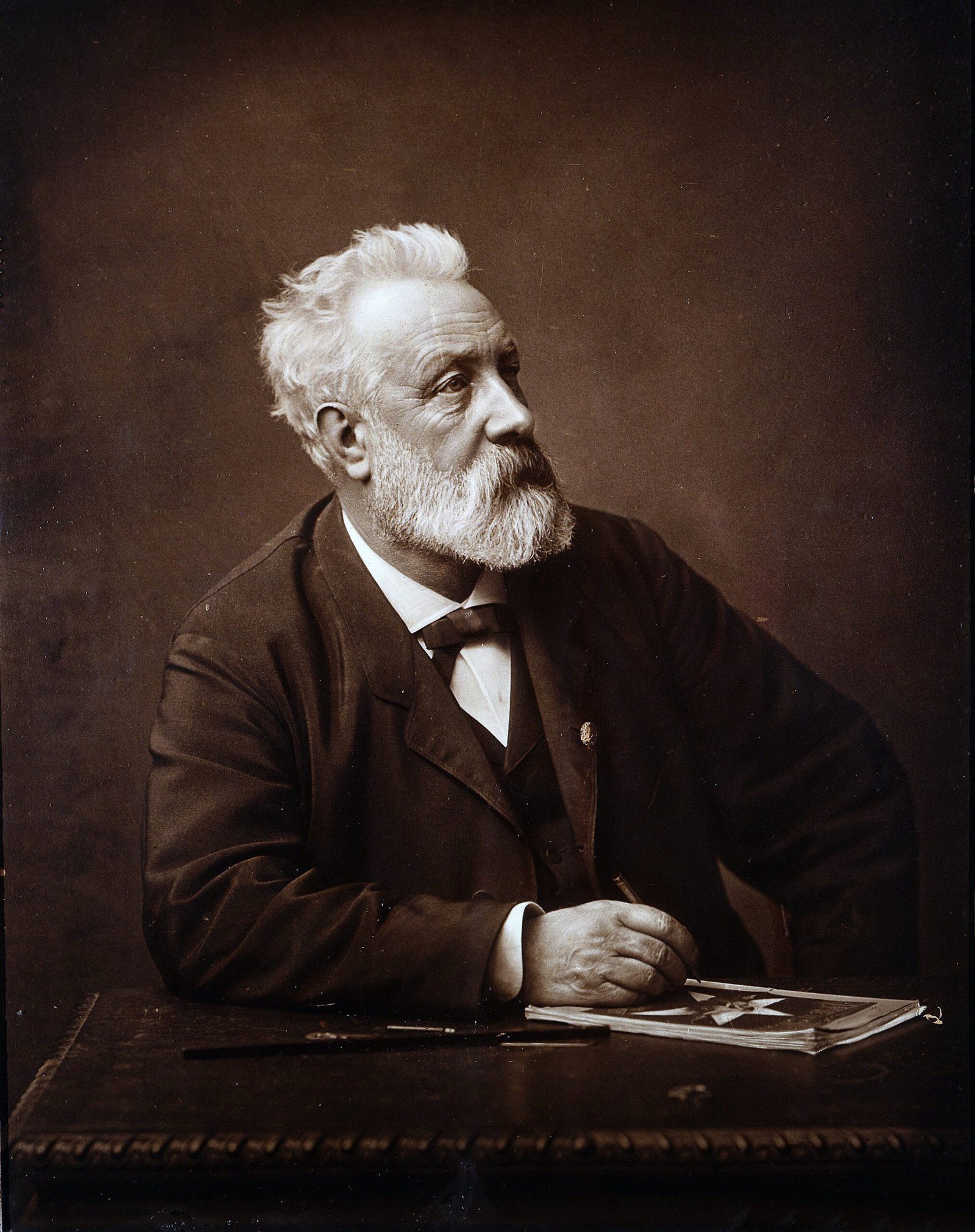
Image credit: Ch. Herbert (Amiens), photograph of Jules Verne, 1892, via Wikimedia Commons. The source identifies the photograph as public domain (Public Domain Mark 1.0).