Alexandre Dumas (1802–1870) gave readers The Three Musketeers and The Count of Monte Cristo, two very different ways of building an adventure: the companionship and political intrigues of one, the imprisonment and elaborate revenge of the other. He was also a successful dramatist and a prolific collaborator. Knowing a little about that working life makes his books easier to approach without reducing their author to a handful of familiar screen adaptations.
Which Alexandre Dumas?
The author discussed here is usually called Alexandre Dumas père, meaning “father,” to distinguish him from his son, the writer Alexandre Dumas fils. The distinction matters in bookshops and catalogues: the shared name does not identify a single author.
Dumas père was born at Villers-Cotterêts in France in 1802. His father, Thomas-Alexandre Dumas, was a general; his paternal grandmother, Marie-Cessette Dumas, had been enslaved in Saint-Domingue. The biographical account at the Château de Monte-Cristo, Dumas’s former home, addresses both this family history and the racist attacks he faced. His ancestry belongs to the history of his public life, not merely to a modern footnote about a famous novelist.
The theatre before the novels
In Paris, Dumas worked as a clerk while pursuing writing. His play Henri III et sa cour succeeded in 1829, well before the novels for which he is most widely read today. Penguin’s author biography places that success within the Romantic movement.
For a reader coming to the novels, the theatrical career offers a useful point of attention. Notice how much can happen through a confrontation, an entrance or an exchange of dialogue. Rather than treating a long novel as a continuous stretch of description, try reading a chapter as a succession of scenes: who knows something, who conceals it, and who arrives at the wrong moment?
Serial publication and collaboration
The Bibliothèque nationale de France’s record for Les Trois Mousquetaires dates its newspaper serialisation in Le Siècle to March–July 1844, before its appearance in book form that year. Its first readers encountered a story delivered in instalments. That publication history is a useful comparison with the serial fiction of Charles Dickens.
Dumas’s production also depended on collaboration. The Château de Monte-Cristo’s account explains Auguste Maquet’s contribution to historical groundwork and plots, alongside Dumas’s transformation of material into scenes and dialogue. Acknowledging Maquet does not require pretending that Dumas’s contribution was negligible. Nor should the famous name on a title page make a collaborator disappear.
These circumstances suggest two questions to carry into the books: how does a chapter make you want the next one, and how does a historical setting become a sequence of dramatic problems? They direct attention towards the work on the page, rather than towards the sheer number of volumes associated with Dumas’s name.
The Three Musketeers or The Count of Monte Cristo?
The Three Musketeers is the natural starting point if you want the company of d’Artagnan, Athos, Porthos and Aramis. The title’s group of three and the presence of a fourth central figure are part of its familiar appeal. A first reading benefits from taking the characters as more complicated than their simplified image in popular culture: follow their decisions rather than relying on what an adaptation has already taught you to expect.
The Count of Monte Cristo begins with Edmond Dantès’s betrayal and imprisonment in the Château d’If. Escape and the discovery of treasure make possible his transformation into the wealthy figure who can act against his enemies. Penguin’s account of Robin Buss’s translation identifies the complete text and its accompanying introduction and notes.
Choose it when you are ready to follow a large cast and a long development of consequences. Keeping a brief list of names can be more useful than consulting a plot summary, which may reveal connections before the novel does. An abridgement can offer a quicker adventure, but it changes the scale of the reading experience; the edition should make that choice clear.
A shorter route: The Black Tulip
The Black Tulip offers a more compact alternative. Set in the Dutch Republic, it follows Cornelius van Baerle, whose ambition to cultivate a black tulip becomes entangled with political accusation and imprisonment. Rosa, the jailer’s daughter, helps him pursue that ambition. Robin Buss’s edition includes an introduction relating the story to Dutch history.
For readers who want to try Dumas before committing to a very long book, that concentration is an advantage. There is still an improbable project, danger and assistance across a prison boundary, but fewer pages to navigate. Readers interested more broadly in the possibilities of an adventure narrative can also explore Mark Twain’s major books, whose American settings offer a different next step.
Reading Dumas in translation
Look for the translator’s name, a clear statement about abridgement and notes explaining historical references. Compare a sample page from two editions if possible: a voice you enjoy will matter over hundreds of pages. Publication dates on modern covers identify those editions, not necessarily the first appearance of the French novel.
There is no need to begin with a complete bibliography. Choose one book, allow its cast time to settle, and follow the individual scenes. Dumas’s career was enormous; a reader’s first encounter can be much simpler.
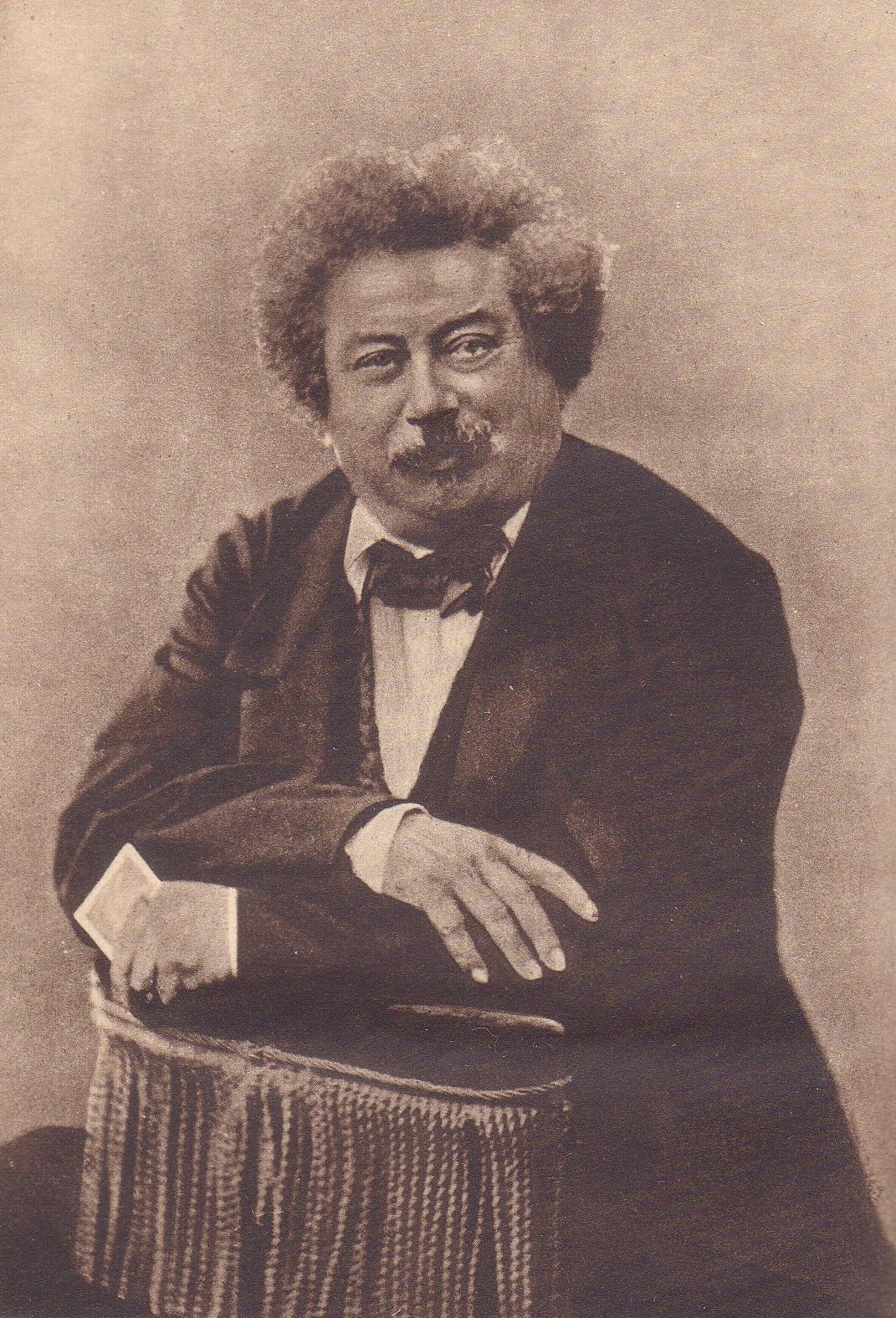
Image credit: Nadar (1820–1910), portrait photograph of Alexandre Dumas père, via Wikimedia Commons. Public domain; Public Domain Mark. Displayed proportionally; no crop or colour alteration.