Charlie Chaplin (1889–1977) is remembered first through a moving image: the Tramp’s costume, gait and improvised encounters with an uncooperative world. Yet Chaplin also wrote memoirs, travel observations and fiction. Reading him alongside his films reveals a performer looking back on poverty, fame and political controversy, as well as a storyteller working out a scene before it reached the screen.
London childhood, stage apprenticeship and film
Charles Spencer Chaplin was born in London on 16 April 1889. His parents worked as entertainers, and his childhood was marked by poverty and family instability. The official biographical overview traces his stage experience, including work with Fred Karno’s company, before his move into American films at Keystone.
His screen career developed rapidly from 1914. In 1919, he joined Mary Pickford, Douglas Fairbanks and D. W. Griffith in founding United Artists. Films such as The Kid (1921), City Lights (1931), Modern Times (1936) and The Great Dictator (1940) belong to different stages of that career, rather than to a single unchanging era of silent comedy.
After leaving the United States in 1952, Chaplin settled with his family in Switzerland. He died there on Christmas Day in 1977. These dates provide the outline; his books supply a much more selective and personal account of how he wanted that life to be understood.
My Autobiography: a life recalled
First published in 1964, My Autobiography moves from a poor London childhood and the music hall to international success in cinema. The Charlie Chaplin Archive’s record documents the book, while Penguin’s edition includes an introduction by Chaplin biographer David Robinson.
Penguin describes a work composed largely from memory when Chaplin was in his seventies. That is an important distinction for a reader. The book is a participant’s retrospective narrative, shaped by recollection and selection; it serves a different purpose from a biography assembled from correspondence, production records and other witnesses.
A productive first reading follows the changes in scale: a child’s immediate needs, a performer’s developing skills, then the pressures of a public life. Keep a separate chronology if you want to check dates, but allow the memoir’s scenes to establish their own rhythm. When an episode raises further questions, Robinson’s biographical work and the Chaplin Archive offer places to continue.
A Comedian Sees the World: the celebrity as traveller
Chaplin’s journey of 1931–1932 produced the material for A Comedian Sees the World. The memoir appeared in five magazine instalments between September 1933 and January 1934. A book edition introduced and annotated by Lisa Stein Haven followed in 2014, as the official publication announcement explains.
It offers a closer view of a particular period than the later autobiography. Chaplin travelled as someone already famous, meeting prominent public figures while observing a world affected by the Depression. Haven’s editorial work places those encounters in context and connects this period with his increasingly explicit political interests.
For readers who enjoy the meeting of a comic personality and unfamiliar places, the travel writing of Mark Twain offers another route through the genre. With Chaplin, ask how celebrity changes an encounter: what can a celebrated visitor see, and what might the attention surrounding him prevent him from seeing?
Footlights and the making of Limelight
Before Limelight became a film, Chaplin developed its story as a novella of roughly 34,000 words, Footlights. It was first published in 2014 in a volume with David Robinson’s The World of Limelight, issued by Cineteca di Bologna. The announcement and description of that edition explain the distinction between Chaplin’s prose and Robinson’s accompanying historical account.
The setting returns to the London entertainment world of Chaplin’s youth. Robinson follows the development of the story and the people, theatres and memories behind it. For a reader interested in adaptation, the volume offers something more specific than a novel later purchased by a film studio: the filmmaker’s own prose preparation for a screen work.
Read the novella before or after watching Limelight, then compare a single scene. What can prose tell you directly about a character that a performer must communicate through movement, speech or timing? What has been condensed or rearranged? Those questions keep the comparison close to the two works instead of assuming that one medium must be superior.
Chaplin among other writers on film
Chaplin also became a subject for writers who worked in cinema themselves. Adelphi’s presentation of Chiuso per noia, a collection of Ennio Flaiano’s film criticism, identifies Monsieur Verdoux among the films Flaiano admired. The connection provides a way to read Chaplin’s work through another practising screenwriter’s response; our guide to Flaiano’s books and film writing introduces that side of his career.
A sensible starting sequence is therefore one memoir and one film, followed by a more focused book. Choose My Autobiography for the life story, A Comedian Sees the World for travel and public encounters, or Footlights for the development of fiction into performance. Check whether an edition contains Chaplin’s writing, a later scholar’s commentary, or both: each offers a different kind of access to the man behind the familiar screen figure.
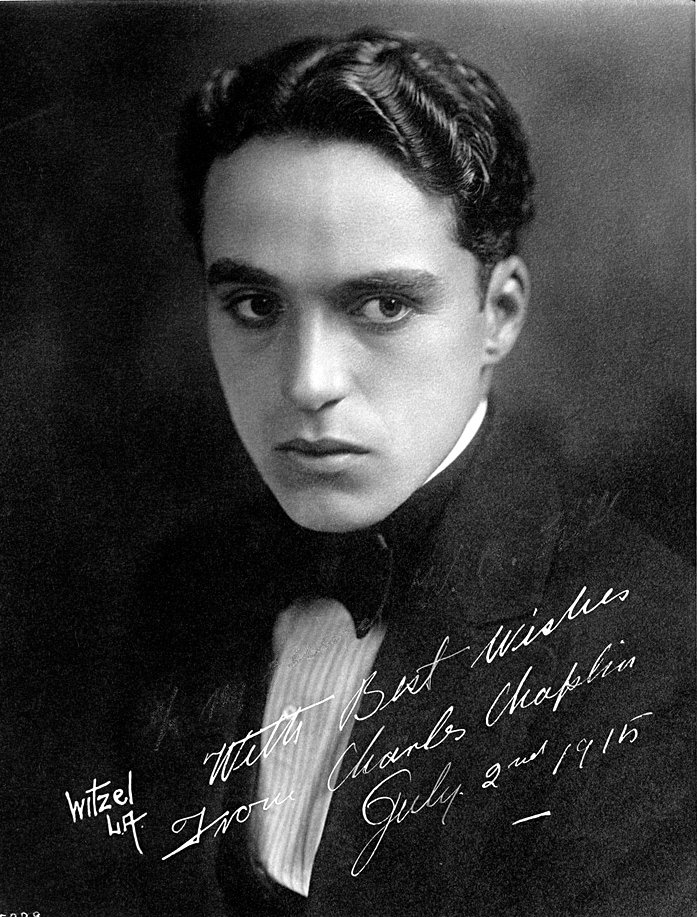
Image credit: Albert Witzel (1879–1929), publicity portrait of Charlie Chaplin, circa 1915, via Wikimedia Commons. Public domain in the United States and countries with a copyright term of life plus 95 years or less; Public Domain Mark. Displayed proportionally; no crop or colour alteration.